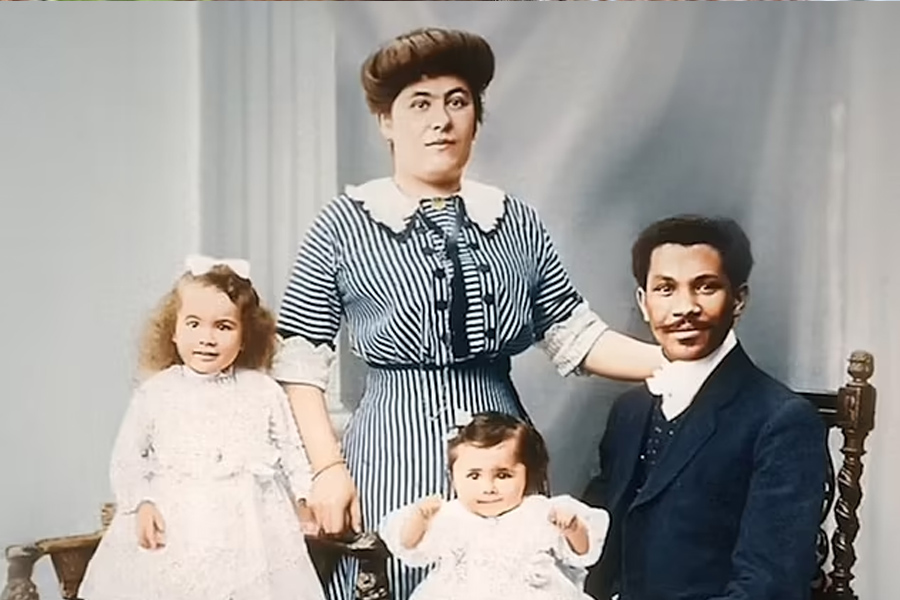
A life shaped by the sea and by resolve
I have always been moved by stories that hinge on a single night when everything changes. Joseph Philippe Lemercier Laroche lived one of those stories. A Haitian trained engineer, he sailed on the RMS Titanic with his French wife, Juliette, and their two young daughters. On the night the ship struck ice, he helped place his pregnant wife and both children into a lifeboat. They survived. He did not. His body was never recovered.
Most records place his birth around 26 May 1886 in Cap Haïtien, though a few accounts give 1889. His death fell on 15 April 1912, the date etched into maritime memory. Between those two markers is the outline of a man who studied, loved, struggled, and took risks for a future he believed his family deserved. What follows is the shape of that life and the family who carried his name forward.
Family roots and the people at the center of his world
Joseph married Juliette Marie Louise Lafargue in March 1908 after studying in France. Juliette was born in the Paris area in October 1889 and lived a long life, never remarrying after the disaster. She died in January 1980 and rests in Villejuif, where her gravestone remembers Joseph as lost at sea on the Titanic.
Their first child, Simonne Marie Anne Andrée, was born in February 1909. A toddler when she crossed the Atlantic, she survived the sinking and later died in 1973. Simonne is often noted as having no recorded descendants.
Their second child, Louise Marie Marguerite, arrived in July 1910 in Paris. Louise survived and became one of the well known Titanic survivors in later commemorations, living until January 1998.
After returning to France, Juliette gave birth to Joseph Jr. in December 1912. He married and had children, passing in January 1987. Through him and his descendants, the Laroche line continued, a quiet thread that ties the family’s harrowing night to the everyday lives that followed.
Joseph’s extended relations included notable Haitian roots. He is widely identified as a nephew of Cincinnatus Leconte, President of Haiti from 1911 to 1912. Some accounts describe Joseph’s father as a French army officer and his mother as Haitian, with ancestry linked in retellings to prominent figures of Haiti’s early independence. Those claims appear often, though the precise details can vary and are not always documented in surviving primary records.
Education, work, and the pull of home
Joseph traveled from Haiti to France as a teenager to study at Beauvais, later completing an engineering qualification. Fluent in French and Haitian Creole, he was poised to begin a career, yet faced constraints in France, especially racial discrimination that limited opportunities and pay. Family reports and later histories say he planned to return to Haiti, where his uncle had arranged a position for him. Accounts describe opportunities in teaching mathematics or in public works, a practical beginning for an engineer in a country that needed skilled professionals.
By early 1912, the plan to resettle had firmed up. The family sought passage, originally looking at another line that enforced strict rules about children in dining areas. They changed plans and booked second class tickets on Titanic. It was a compromise, one that felt sensible at the time. The ship was new, celebrated, and promised safe passage to a new start.
The voyage and the night of April 15, 1912
The Laroches boarded Titanic at Cherbourg on 10 April 1912. For days, the ocean seemed to stretch like a quiet avenue beneath them. Then came the collision with ice. In the confusion, Joseph did what so many fathers do on instinct. He led his family toward safety, guided his wife into a seat, lifted his daughters, and stayed behind on the deck. The image that remains is one of calm courage, of duty carried to the edge.
Juliette and the children were rescued and taken aboard Carpathia. They arrived in New York on 18 April. With her husband gone and the path uncertain, Juliette returned to France, choosing familiar ground over the unknown journey to Haiti. She rebuilt a life one day at a time, welcoming Joseph Jr. later that year.
Rumors and reality
I have read the variations and the retellings, and I try to keep the heartbeat of the story separate from the noise. The claim that Joseph was the only adult Black passenger on Titanic appears widely and reflects how he is remembered. Some passengers of mixed or ambiguous heritage are sometimes discussed, but the recurring phrasing centers on Joseph as the only adult Black passenger recorded on the manifest.
Other claims belong in the realm of family history and oral tradition. Lineage linking Joseph to major figures of Haitian independence is often repeated but not universally confirmed through primary documents accessible today. Assertions about his father’s military role also appear in many accounts without firm archival anchors. I acknowledge them while holding them with care.
Legacy, memory, and the long arc of a family
Legacies can be robust or fragile. Joseph’s is both. His story reappears each year during Titanic anniversaries and during Black History Month. For decades, Louise spoke on panels and took part in commemorations, her memories serving as a lantern for the rest of us. Simonne lived a quieter life. Juliette endured, a widow who never remarried. Joseph Jr. carried the name forward and formed a branch with descendants who are often noted in genealogical records.
There is no reliable record of Joseph’s net worth. The family bought tickets and had connections that suggest some means, yet his career had only just begun. The historical ledger has no neat column with a number beside his name. What remains instead is the measure of his actions in the minutes that mattered most.
Timeline highlights
- 1886 or 1889: Joseph Philippe Lemercier Laroche is born in Cap Haïtien, Haiti
- Early 1900s: Sent to France to study, later trained as an engineer
- 18 March 1908: Marries Juliette Marie Louise Lafargue
- 19 February 1909: Daughter Simonne is born
- 2 July 1910: Daughter Louise is born
- 10 April 1912: Family boards Titanic at Cherbourg as second class passengers
- Night of 14 to 15 April 1912: Titanic strikes ice and sinks; Joseph’s wife and daughters survive
- 18 April 1912: Survivors arrive in New York aboard Carpathia; Juliette returns to France
- 17 December 1912: Joseph Jr. is born in France
- 8 August 1973: Simonne dies
- 10 January 1980: Juliette dies in Villejuif
- 28 January 1998: Louise dies after decades of survivor commemorations
What we know and what remains uncertain
When I sift through the record, I find solid ground and soft soil. Solid ground includes his education in France, the marriage to Juliette, the births of their children, and the events of the voyage. Soft soil includes precise details about his parents and some ancestral claims that circulate widely without consistent primary documentation. Financial records are also thin, which leaves us with a portrait painted largely from family testimony and survivor histories rather than ledgers and contracts. That is often the way with lives cut short.
FAQ
Was Joseph Philippe Lemercier Laroche the only Black passenger on the Titanic
Many retellings identify Joseph as the only adult Black passenger aboard the ship. His daughters are also noted as children of African ancestry. Discussion sometimes arises about other passengers of mixed heritage, but Joseph is repeatedly centered in historical summaries.
Why did the Laroche family change ships and end up on the Titanic
Accounts describe child seating policies on another line that led the family to alter their plans. They booked second class on Titanic, a decision framed by comfort, practicality, and the promise of a swift journey to a new life in Haiti.
What was Joseph’s profession and did he have an established career in France
Joseph trained as an engineer in France. He faced difficulties securing appropriately paid work due to racial discrimination in the labor market, which contributed to his plan to return to Haiti where a position had been arranged for him.
Did Joseph’s body ever turn up after the disaster
No. His body was never recovered. Like many who remained aboard as lifeboats pulled away, he vanished into the sea and the lists of the lost.
Who were Joseph’s immediate family members and what became of them
He was married to Juliette Marie Louise Lafargue. Their daughters were Simonne and Louise, both Titanic survivors. After returning to France, Juliette gave birth to Joseph Jr., who married and had children. Simonne died in 1973, Juliette in 1980, and Louise in 1998.
Is there proof of Joseph’s ancestry linking him to major figures in Haitian history
Joseph is widely identified as a nephew of Cincinnatus Leconte, President of Haiti. Other lineage claims appear often, including links to prominent revolutionary figures, but consistent primary records are not readily available. These details should be approached with care.
Do we know Joseph’s net worth at the time of the voyage
No reliable financial data survives that would allow a credible estimate. The family had the means to travel and had influential connections, but Joseph’s career had not yet reached a point where public financial records would provide clarity.
Why did Juliette return to France instead of continuing to Haiti after surviving
Surviving a disaster can reset every plan. With her husband gone and a young family to care for, Juliette returned to familiar ground in France. She gave birth to Joseph Jr. later that year and built a life in the country she knew.